
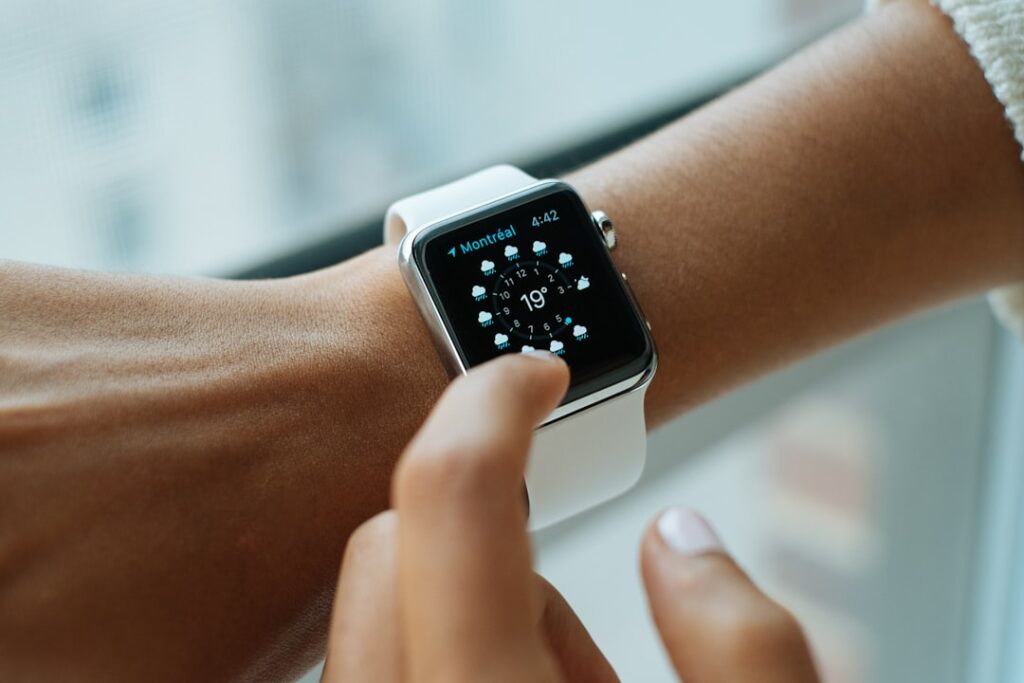
Film professionals should use wearable recovery data as a trend, not a command. Heart-rate variability, resting heart rate, sleep estimates and readiness scores can support a decision when they are compared with a consistent personal baseline and combined with how the person feels. One red score cannot diagnose poor recovery or automatically cancel training.
As of 08/2026, wearable technology is the American College of Sports Medicine’s number-one fitness trend for 2026. ACSM also warns that device accuracy and the reliability of advanced metrics vary.
What changed?
- 08/2026: Added ACSM’s 2026 wearable-technology trend data and accuracy warning.
- 08/2026: Added a production-specific decision process for night shoots, travel and repeated takes.
What does HRV mean on a fitness wearable?
Heart-rate variability, or HRV, describes variation in time between heartbeats. Many wearables calculate nocturnal HRV and compare the result with a personal range. Training, sleep loss, illness, alcohol, psychological stress, travel and measurement conditions can all change the number.
The useful question is not whether one HRV reading is high or low compared with another person. The useful question is whether the reading has changed from a consistent personal baseline and whether other recovery signals changed at the same time.
Which wearable signals are useful for film professionals?
| Signal | What it may help show | Main limitation |
|---|---|---|
| HRV trend | Change in autonomic response across several nights | Sensitive to device, timing, illness, alcohol and individual variation |
| Resting heart rate | A simple trend that may rise during stress or illness | Affected by heat, hydration, medication and measurement quality |
| Sleep duration estimate | Whether sleep opportunity is shrinking across calls | Consumer devices can misclassify wake and sleep stages |
| Readiness score | A convenient summary of several inputs | The algorithm is proprietary and can hide which signal changed |
| Steps or activity load | A rough view of movement volume on long workdays | Does not capture technical difficulty, load carried or psychological demand |
| Self-reported fatigue | Context that a device cannot observe | Subjective and affected by mood, expectations and reporting habits |
How long does a film professional need to build a baseline?
A practical starting point is two to four weeks of consistent wear before making strong decisions from a recovery score. The baseline should include ordinary work and training days, not only a holiday or a peak production week. Measure under similar conditions and use the same device when possible.
Research on nocturnal HRV suggests that some consumer devices can track it with reasonable validity, but agreement varies by device and metric. Sleep studies also show that consumer wearables are better at estimating broad sleep patterns than identifying every sleep stage precisely.
How should wearable data change a training decision?
- Check the trend: compare the result with the person’s recent baseline, not a public ideal.
- Check the context: note call time, night work, travel, alcohol, illness symptoms, menstrual-cycle context where relevant and the previous day’s physical load.
- Check the person: record energy, soreness, motivation, pain and performance in the warm-up.
- Choose the smallest useful adjustment: keep the session, reduce volume, change intensity, use recovery work or rest.
- Review the next day: one score matters less than the direction across several days.
What should happen after one poor readiness score?
One poor readiness score should trigger a check, not an automatic cancellation. If the performer feels normal, the warm-up is good and no other signal has changed, the planned session may continue with normal monitoring.
If several signals move together, such as lower HRV, higher resting heart rate, short sleep and falling performance, reduce the training demand. A short familiar strength session, easy aerobic work or rest may be more useful than forcing the planned workload.
How can wearables help during night shoots?
Night work changes sleep timing and circadian rhythm, so readiness scores may fall even when the person uses sensible recovery habits. The device can help show a pattern across several calls, but it cannot create more sleep opportunity or determine whether a performer is safe to work.
Use the wearable to support practical actions: protect the next sleep window, reduce unnecessary training, keep hydration and food regular, and avoid testing fitness during the hardest overnight block. See night-shoot recovery for film crew for the broader plan.
What are the biggest wearable mistakes?
- Chasing a perfect score: recovery data should support work, not create anxiety about normal variation.
- Comparing people: HRV values and readiness algorithms are not directly interchangeable between performers.
- Ignoring the production load: a device cannot fully measure costume heat, repeated takes, set stress or technical rehearsal.
- Treating sleep stages as exact: consumer wearables estimate sleep and can misclassify stages or wake time.
- Using data as a diagnosis: unusual symptoms or persistent changes need healthcare assessment, not an app interpretation.
Who should have access to performer recovery data?
Recovery data is personal health-adjacent information. A performer should understand what is collected, who can see it and how it will be used. A production or coach should not pressure a person to share consumer wearable data or treat a readiness score as proof of fitness for work.
TraceFit uses wearable trends only as one input within a wider film-industry fitness plan. Symptoms, pain and medical concerns remain outside the scope of a consumer device.
Frequently asked questions
What is a good HRV score for a stunt performer?
There is no universal good HRV score for a stunt performer, so the useful comparison is the performer’s own consistent baseline and trend.
Can a wearable tell a film professional to skip training?
A wearable can flag a change, but a training decision should also consider sleep, symptoms, workload, self-reported fatigue and warm-up performance.
Are wearable sleep stages accurate?
Consumer wearables can estimate broad sleep patterns, but sleep-stage classification is not precise enough to treat every nightly stage total as exact.
Can HRV diagnose overtraining or illness?
HRV cannot diagnose overtraining or illness because many physical, behavioural and measurement factors can change the value.
Sources and further reading
- American College of Sports Medicine: Top fitness trends for 2026
- Systematic review: Monitoring training adaptation and recovery status with HRV
- Validation study: Nocturnal resting heart rate and HRV in five wearable devices
- Study: Accuracy of commercial wearable devices for sleep monitoring
- NIOSH: Shift work and long work hours
Featured photo by Luke Chesser on Unsplash.
About the author
Kundai Murapa is a Cape Town-based professional stunt performer and film-industry fitness coach. Working in film since 2012, he founded TraceFit to provide strength, conditioning and functional mobility programmes for actors, stunt performers and film crews.
Explore Fit2Film coaching for production-ready training and recovery.
